Friday, July 10, 2015

Washington Monument - 2

(see previous post)


The pedestal and equestrian Washington are in the center a platform reached from four sides by 13 steps (13 original states). At the four corners of the platform are fountains, representing four rivers - the Hudson, Delaware, Potomac, and Mississippi. The rivers are guarded by American animals and served by allegorical figures of Native Americans set amidst native flora and fauna.

To my mind, these fountains with their symbolic river figures and guardians are the most interesting and accessible aspects of the Washington Monument. A sampling ...

River Fountain
Fisherwoman


Elk
 

Moose

Bear

Bison
There is still much to be discovered, and photographed, in the monument, so I will probably return to it in the future.

Tuesday, July 7, 2015

Washington Monument - I

The city fathers of Philadelphia were embarrassed in 1824 when they were unable to show the visiting Marquis de Lafayette a single memorial to George Washington.

The Society of Cincinnati of Pennsylvania (an organization of descendants of officers who had served under Washington) began to raise money for a monument as early as 1810. Eventually the Society raised an estimated $250,000 (an enormous sum in the 19th century), and contracted with the well-known German sculptor, Rudolph Siemering. The monument was unveiled in 1897 at an entrance to Fairmont Park. With the completion of the Franklin Parkway, it was moved to its present location in Eakins Circle in 1926.


Washington Monument (Eakins Circle)
Washington Monument - Ericsson Fountain in foreground

Washington Monument - Museum of Art in background

At the top of the monument, General George Washington, in the uniform of the colonial army, is mounted on horseback, leading his countrymen and women in the battle for independence.

George Washington
George Washington (detail)

The equestrian Washington is on a high granite pedestal. The iconography of the pedestal is complex, and for modern viewers unaccustomed to getting their history lessons in a visual, sculpted medium, may be a confusing jumble that conveys very little. In what follows, I have just a sampling of the "message in the medium."

Two allegorical figures are on the front and back of the pedestal. On the front is an allegorical figure representing America. She has a cornucopia in one hand and a trident in the other. Chains have been cast off and she receives from her sons the trophies of her conquest. Below "America" is an eagle supporting the arms of the United States.


"America"

"America" - cornucopia (l) - olive branch of peace (r)

On the back side of the pedestal, America rouses her sons to a sense of their slavery.

"America"
More with the next post.

Saturday, July 4, 2015

Washington Square - Tomb of the Unknown Revolutionary Soldier

After the Declaration of Independence was signed on July 4, 1776, there was a long struggle to make the document a reality.

"Southeast Square" was one of William Penn's five designated "green" spaces. In colonial times it often served as a pauper's field. In 1825, it was renamed in honor of George Washington


Washington Square - fountain and monument
During the War for Independence, the British held Philadelphia. Soldiers of Washington's army who were prisoners of war often died of wounds and sickness. The British hauled their bodies to the square and buried them in unmarked graves.

"The Tomb of the Unknown Revolutionary Soldier" honors these soldiers.

Tomb of the Unknown Revolutionary Soldier

The monument includes a  a tomb with remains of a soldier disinterred from the park, an eternal flame ...

Eternal Flame

... and a bronze cast of Houdon's statue of Washington.

George Washington (bronze cast from Houdon's statue)

George Washington (detail)

Thursday, July 2, 2015

Anne d'Harnoncourt Sculpture Garden

Walk through the Anne d'Harnoncourt Sculpture Garden (Philadelphia Museum of Art) for a delightful display of contemporary sculpture.

These photos are not exhaustive, but give a feel for the variety of shapes and forms that grace the garden, provoke the mind, and fill the senses ...

"Giant Three-Way Plug, Scale A," Claes Oldenburg, 1970 (installed 2010) and "Lips," Franz West, 2012

Giant Three-Way Plug and Lips

"Giant Three-Way Plug, Scale A,"

Giant Three-Way Plug
  "Lips,"
 
Lips

"Bench and Table," Scott Burton, 2001

Bench and Table

Bench and Table

"Two Part Chair," Scott Burton, 1986 (fabricated 2002)

Two Part Chair

"Flukes," Gordon Gund, 2007

Flukes

"Steel Woman," Thomas Shutte, 1999

Steel Woman

Monday, June 29, 2015

Rittenhouse Square

Rittenhouse Square is one of William Penn's planned urban green spaces - and a delightful one - an oasis of green (and purportedly during migration a real birding hotspot), set among luxury high rise apartment buildings. It is considered one of the finest urban spaces in the United States.

Public art graces the space.

"Duck Girl," Peter Manship, 1911

"Duck Girl,"
"Duck Girl,"

"Billy," Albert Laessie, 1914

"Billy"

"Billy"
 "Lion Crushing a Serpent," Antoine Louis Barye, 1832

Lion Crushing a Serpent

Lion Crushing a Serpent

"Sundial (The Hour Passes)," Beatrice Fenton, 1947

Sundial (The Hour Passes)

Sundial (The Hour Passes)


"Giant Frog," Cornelia Chapin, 1941

Giant Frog

Giant Frog

Even the maintenance shed in the park is more than just a utilitarian shed, as evidenced by the shed door ...


Friday, June 26, 2015

Public Art in Philadelphia

We've had a week in Philadelphia and a couple of marvelous summer days. Took an early bus into Center City and the museum district, then walked, photographed, and enjoyed.

Philadelphia is rich with public art, with surprises and delights abounding. From the mid-1800s to the present, statuary, monuments, tributes, and art for itself have adorned the city. I'll post some of the "traditional" sculpture soon, but I need to begin this new series of posts with a few "abstract" pieces that surprised and delighted us on our perambulations.

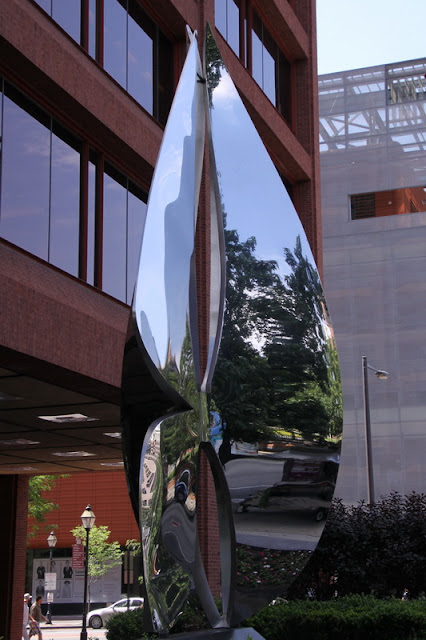
"Gift of the Winds" - by Joseph C. Bailey, 1978 (5th & Market) - stainless steel and manganese bronze. The polished steel reflects the leaves of the sculpture - and the buildings, trees, people, cars, sky - in a constantly changing collage of abstraction and visual delight. The lingering impressions on the mind delight ...

Gift of the Wind
Gift of the Wind

Gift of the Wind
On a very different note is the sculpture (Nissa's favorite on our walk), "Starman in the Ancient Garden", Brower Hatcher, 1990 (9th & Walnut). A space traveler crash lands on a city plaza. The interior of the meteor like star trail has an assortment of civilization's relics picked up during his space travels. The sculpture is both massive and airy, serious and whimsical ...

Starman in the Ancient Garden
Two additional "modern" sculptures grabbed my attention. In a plaza around the corner from "Gift of the Winds" is "White Water", Robinson Fredenthal, 1978 (near 5th & Market).

White Water
And finally, "Triune". I have posted on this sculpture previously. Our recent walk was in the morning, with crisp clear sunlight. It is a piece that captivates me every time I see it ...

Triune

Wednesday, March 18, 2015

Clothespin

On a small corner plaza across from City Hall, and amid soaring high rises, "Clothspin" by Claes Oldenburg sweeps upward from the busy streets.

Clothspin
The stylized object brings different reactions from viewers, such as the passerby who commented soon after its installation that "Center Square needs some humor."

Clothespin


While flying over Chicago, Oldenburg noticed a "similarity" between the building below and a clothespin he was playing with. Driving near center city a couple of days ago, I was struck by the affinity in form between the sculpture and the modern skyscrapers.

While clothespin is apparently an everyday item, it is also suggestive of two bodies embracing, and Oldenburg himself compared the sculpture to Constantin Brancusi's "The Kiss" in the Philadelphia Museum of Art.

The Kiss - Constantin Brancusi

Clothespin - detail
The great thing about this public art is that it is available to everyone, and can bring wide and varied reactions - positive, negative, humorous, imaginative, delight, scorn, pleasure, outrage.

For example, across the street from Clothespin is "The Triune" (see post Triune post in February). Apparently, a lot of people compare it to a pretzel. I see playing dolphins, or a diving whale ... sometimes. Other times it strikes me as an allegory juxaposing the complexity of city bureaucracy (ornate City Hall) with the simple sweeping lines always in motion ....

The Triune